|
|
Identification Of Buildings Utilizing Truss Type Construction |
| By Fire Chief Christopher Taylor | |
| June 8, 2005 | |
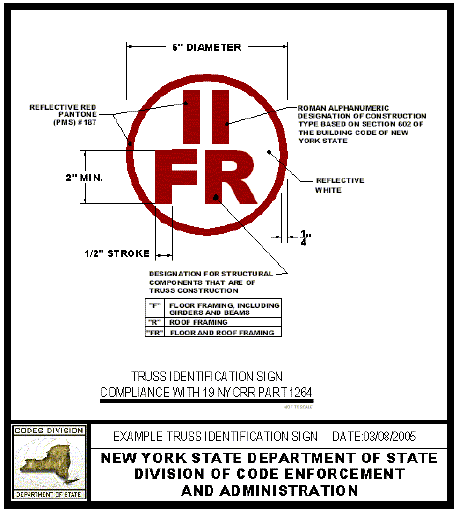
| New York's Uniform Fire Prevention and Building Code was modified effective December 29, 2004 to assist firefighters and emergency personnel in the identification of buildings utilizing truss type construction. Subchapter C of Chapter XXXIII of Title 19 of the Official Compilation of Codes, Rules and Regulations of the State of New York was amended by adding a new Part 1264. Engineered building components may provide adequate strength under normal loading; but under fire conditions, these truss systems can become weakened and fail, leading to the collapse of roofs, floors, and possibly the entire structure. Truss systems are usually hidden, and fires within truss systems may go unnoticed for long periods of time, resulting in loss of integrity. Structural design codes often do not factor in this decreased system integrity, as fire degrades the structural members. Firefighters typically rely on warning signs to indicate imminent truss failure such as roofs and floors that feel spongy or are visibly sagging. Quite often, these warning signs are not good predictors of truss system failures. Numerous studies have been completed showing the hazards truss construction can present to firefighters when the unprotected truss is exposed to fire. According to a 1992 book by retired FDNY Deputy Chief Vincent Dunn, an expert in the field of building construction, at least three scenarios can occur in which firefighters suffer fatalities and injuries while operating at fires involving truss roof and floor systems: 1. - While firefighters are operating above a burning roof or floor truss, they may fall into a fire as the sheathing or the truss system collapses below them. 2. - While firefighters are operating below the roof or floor inside a building with burning truss floor or roof structures , the trusses may collapse onto them. 3. - While firefighters are operating outside a building with burning trusses , the floor or roof trusses may collapse and cause a secondary wall collapse. Many states have adopted similar codes to assist firefighters in identifying properties utilizing truss type construction. The complete text can be downloaded from the New York State Department of State Division of Code Enforcement and Administration website. The links for the text and sample sign layout are listed below. Sample Sign - http://www.dos.state.ny.us/code/pdf/TRUSS.pdf
The first property in the Village of Potsdam that requires the truss identification signs under the new code is presently under construction. This building will be the new home to Scoopuccino, a new and larger version of Michele Sheehan's Scoops, and is being built at 167 Market St. Any questions regarding the new code requirements can be directed to the Village of Potsdam Code Enforcement Office at 265-7678 or the Town of Potsdam Code Enforcement Office at 265-0670. |
|
|
|